
The 1991 Gulf War Showed What Happens When a Ceasefire Replaces a Strategy, And Iran Is Heading Down the Same Path
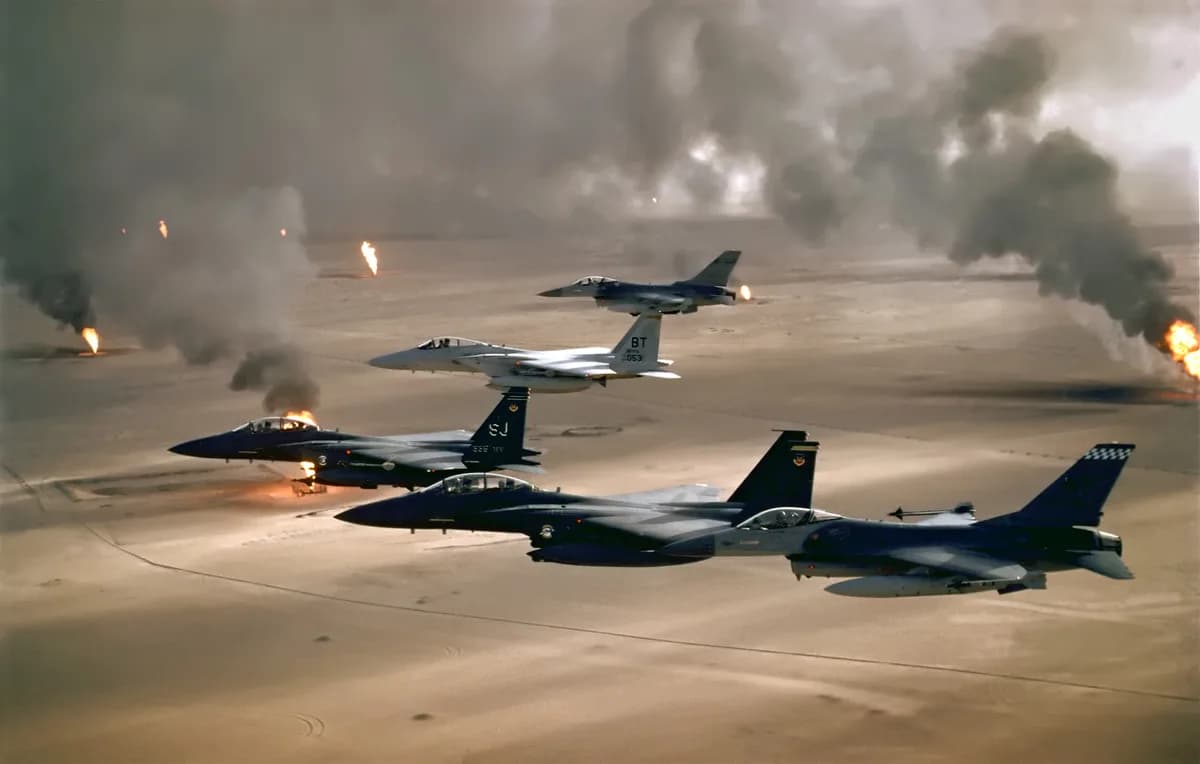
Historians warn that the US-Iran ceasefire mirrors the post-Desert Storm containment trap that produced 12 years of failed policy and ultimately led to the disastrous 2003 Iraq invasion.
Hours after the United States and Iran announced a two-week ceasefire on April 8, 2026, commentators reached for the obvious historical parallel: the 2003 US invasion of Iraq. But in a Foreign Affairs essay that cuts against the prevailing narrative, historians Daniel Chardell and Samuel Helfont argue that the more instructive, and more alarming, comparison is not 2003 but 1991.
The Gulf War ended with a decisive American military victory. Saddam Hussein's army was shattered. But the United States left the Iraqi dictator in power, declared a ceasefire without a comprehensive political settlement, and embarked on what became 12 years of failed containment, no-fly zones, sanctions, periodic airstrikes, and mounting pressure that ultimately produced the catastrophic 2003 invasion. Chardell and Helfont argue the United States is now replicating this pattern with Iran.
How the 1991 ceasefire became a trap
What is a ceasefire?
A ceasefire is a temporary halt to fighting between warring parties. Unlike a peace treaty or armistice, it does not resolve the underlying political or territorial disputes that caused the conflict. Ceasefires can be unilateral or mutual, formal or informal, and they can last hours or decades. Research shows that ceasefire agreements fail roughly 80% of the time, but paradoxically, the best predictor of a successful ceasefire is how many previous failed attempts preceded it.
After Desert Storm in 1991, the United States destroyed Iraq's conventional military capability but left its regime intact. Washington then demanded that Baghdad dismantle its weapons of mass destruction but offered no path to normalization even if Iraq complied. Secretary of State James Baker declared: "No one, I repeat, no one, should conduct any normal business with an Iraqi government headed by Saddam." This created a perverse incentive structure: Iraq had nothing to gain from compliance and everything to gain from obstruction.
The result was 12 years of simmering conflict. No-fly zones, intended as temporary measures, became permanent. Sanctions devastated Iraqi civilians while strengthening the regime's grip on power. US forces became, in effect, "regional police" locked in an indefinite containment mission that eroded international support, alienated allies, and generated mounting bipartisan pressure for regime change, producing the very invasion it was meant to prevent.
Iran faces the same dynamic
The parallels to 2026 are striking. The United States has walked back its initial demands for regime change, and the ceasefire terms implicitly accept the Islamic Republic's continued existence. But Iran remains, in the authors' words, "weakened but still capable of threatening its neighbors." Its nuclear infrastructure is damaged but not eliminated. Its proxy networks are degraded but not destroyed. Its control of the Strait of Hormuz gives it leverage it did not possess before the war began.
As a CSIS analysis by Daniel Byman notes, "The ceasefire is less a resolution than a pause in a conflict whose underlying drivers remain not only intact but, in some cases, intensified." Over 250 high-ranking Iranian officials have been killed, virtually guaranteeing cycles of revenge. Iran's parliament has voted to end all cooperation with the International Atomic Energy Agency.
The authors' core policy recommendation: Washington must offer Tehran a genuine path to diplomatic and economic normalization in exchange for compliance with clear demands, including abandoning its nuclear weapons program. "To avoid repeating the disasters that followed the misguided policy toward Iraq," they write, "Trump must be prepared to do what leaders could not in the 1990s: take yes for an answer from even the most dislikable foe."
A critical difference the authors acknowledge
Perhaps the most important distinction between 1991 and today is one the authors themselves highlight: "The United States no longer enjoys its status as the world's sole superpower." China, Russia, and regional powers have far more capacity to support Iran and undermine containment than any actor could do for Iraq in the 1990s. If the US attempts a decades-long containment strategy, it will face far stiffer headwinds, and the costs will compound faster.
As Time magazine's analysis concluded: "A war paused without a political framework is not a conflict resolved. It is a conflict deferred." The question is whether Washington has learned enough from its own history to avoid deferring this conflict into something worse.