
A Medieval Kurdish Tombstone at Gevaş Exposes Turkey's Heritage Erasure Machine
2. A medieval Kurdish tombstone at Gevaş exposes Turkey's heritage erasure machine
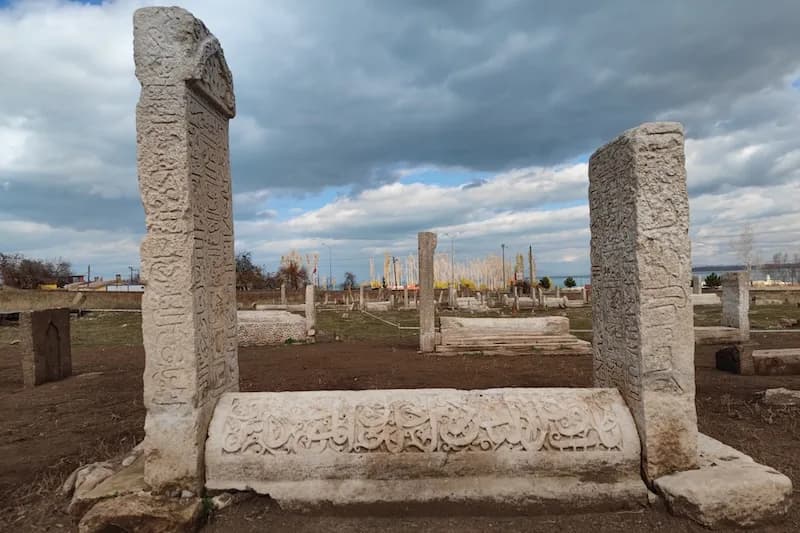
In March 2026, Ercan Çalış and Yazar Korkmazer of Van Yüzüncü Yıl University published their analysis of a unique tombstone discovered in the Gevaş cemetery near Lake Van, the only figural tombstone among nearly 1,000 documented graves at the site. Carved from white limestone and featuring a striking double-headed dragon motif within a pointed-arch niche, the tombstone is dated to 710 AH (1310–1311 CE) and identifies the deceased through an Arabic inscription. The mason is recorded as Yusuf son of Miran, and Miran is one of the most prominent Kurdish tribal names in the Lake Van region.
The Miran tribe (Kurdish: Mîran, meaning "the princely ones," from Mîr, prince) was, according to the British Consul for Kurdistan, "one of the most influential and richest tribes in the area around the highlands to south of Lake Van." The mason's name is thus a direct marker of Kurdish craftsmanship in the medieval period.
The "Seljuk" label is historically impossible
Çalış and Korkmazer label this artifact "Seljuk", yet the Seljuk Sultanate of Rum ceased to exist in 1308, two to three years before the tombstone was carved. After the Mongol defeat of the Seljuks at Köse Dağ in 1243, the sultanate became a vassal state; its last sultan, Mesud II, was murdered in 1308 with no successor appointed. By 1310, the Van/Gevaş region was under Ilkhanid Mongol suzerainty and the expanding authority of Kurdish principalities.
Alexander Khachatrian's research in Iran and the Caucasus (Brill, 2003) confirms that "several Kurdish fiefdoms can already be noticed in South Armenia in the 14th century," specifically identifying the Van-Vostan area as a Hakkari Kurdish tribal fiefdom, the very region where the tombstone was found. The most prominent monument in the same cemetery, the Halime Hatun Tomb (1358), was built for a princess who married "the Kurdish emir of Hakkari, at that time the ruler of this area." The Emirate of Hakkâri, founded by Izz al-din Shir, would rule Van, Vostan, and surrounding territories until 1845.
A systematic pattern of cultural appropriation
The Gevaş case is not isolated. The cemetery itself is officially designated "Gevaş Selçuklu Mezarlığı" (Seljuk Cemetery) despite containing tombstones exclusively from the post-Seljuk period. Turkish state media uniformly employs this framing, and the site has been adopted by the presidency's "Geleceğe Miras" (Legacy for the Future) program, further institutionalizing the mislabel. The Kurdish mason's tribal identity receives no discussion in any Turkish reporting.
Sara Kuehn's The Dragon in Medieval East Christian and Islamic Art (Brill, 2011) demonstrates that dragon motifs in the Lake Van region represent a multicultural artistic vocabulary spanning Central Asian, Persian, Armenian, and broader Islamic traditions, not an exclusively "Turkish" phenomenon. This pattern extends beyond individual artifacts. Turkey's systematic Turkification of place names, replacing Kurdish, Armenian, Greek, and Assyrian toponyms, has been extensively documented.