
Europe Prepares to Defend Itself as America Steps Back, But Can Four Nations Carry the Continent?
Germany, Poland, France, and the United Kingdom are emerging as the core of a new European defense architecture. Whether they can replace decades of American protection remains an open question.
Europe faces its most consequential defense challenge since the Cold War. NATO Secretary General Mark Rutte warned in June 2025 that "Russia could be ready to use military force against NATO within five years." US officials told their European counterparts in December 2025 that they must assume "primary responsibility for Europe's defense by 2027." And the January 2026 US National Defense Strategy explicitly deprioritized the continent, focusing instead on China and the Indo-Pacific.
Against this backdrop, a Foreign Affairs analysis by Princeton's Ethan B. Kapstein and the IISS's Jonathan Caverley argues that Europe's security will not be forged in Brussels, with its slow-moving institutions and limited defense expertise, but by four key nations acting largely on their own: Germany, Poland, France, and the United Kingdom. "Europe's security depends on them, and only them," the authors write.
Why Brussels cannot lead the defense buildup
The European Union has responded to the crisis with ambitious programs and sweeping rhetoric. The ReArm Europe initiative aims to mobilize up to €800 billion in defense investment over a decade. The Security Action for Europe (SAFE) program offers €150 billion in Brussels-backed loans. Eighteen member states have applied for funding.
But Kapstein and Caverley argue these efforts are "too slow to meet likely timelines for a U.S. withdrawal." The EU spends just €4.6 billion per year on coordinated weapons research and procurement, roughly 1% of its members' combined defense budgets. The bloc lacks, in the authors' words, "the capacity, expertise, or democratic legitimacy" to answer the fundamental questions of European defense.
The Future Combat Air System (FCAS), a joint fighter jet project between France, Germany, and Spain, illustrates the problem. France wants a light, carrier-capable aircraft that can deliver nuclear weapons. Germany wants a heavy air-superiority platform designed to penetrate Russian defenses. The project is, according to the article, "almost certainly headed for radical reorganization, if not outright collapse."
What is NATO?
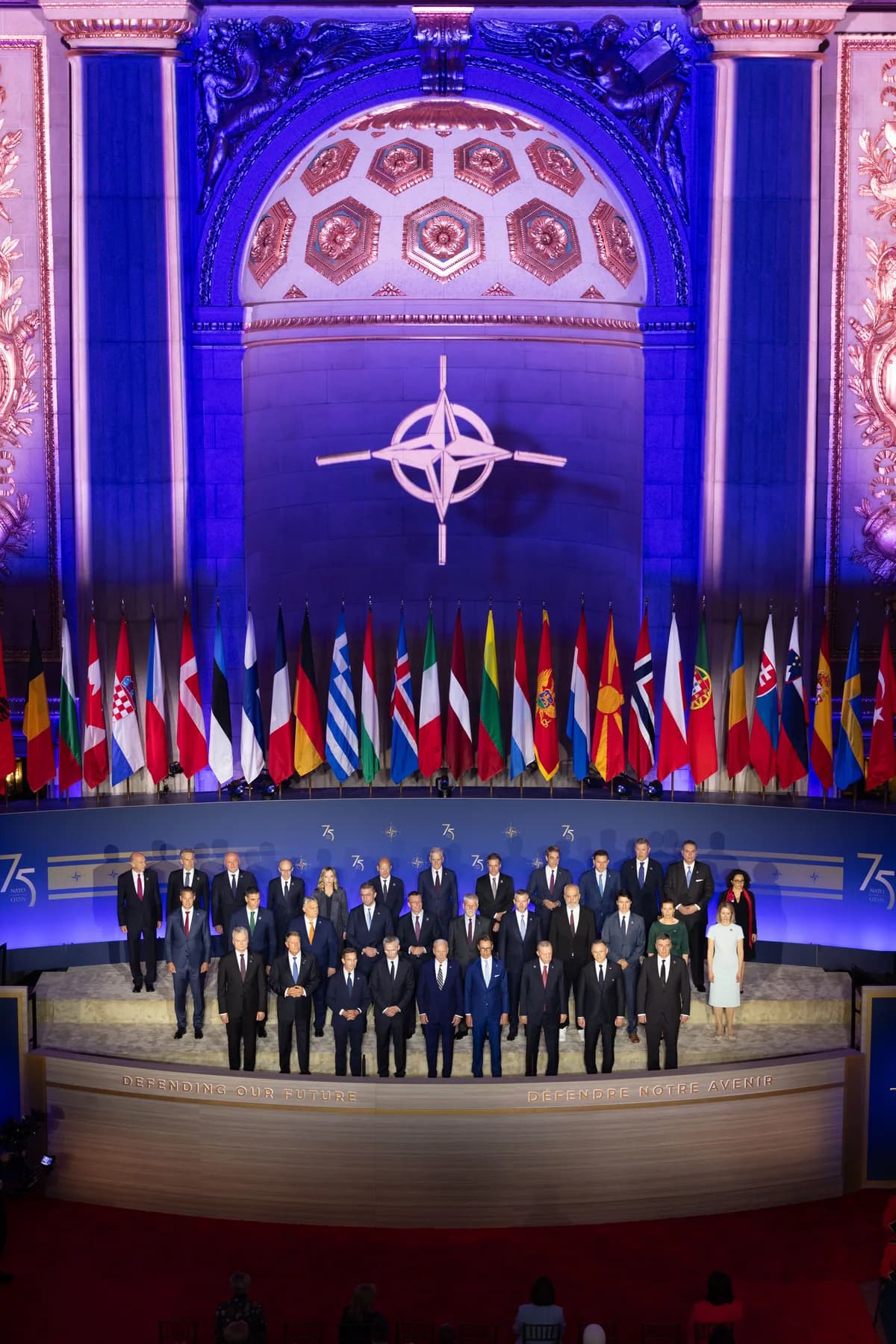
The North Atlantic Treaty Organization was founded in 1949 as a collective defense alliance, now comprising 32 member states across North America and Europe. Its cornerstone is Article 5, which states that an armed attack against one member is considered an attack against all. Since its founding, the United States has been NATO's dominant military and financial contributor, a dynamic that has generated decades of debate over burden-sharing, the question of whether European allies spend enough on their own defense.
Germany's transformation leads the way
The numbers tell a dramatic story. Germany has doubled its defense budget since 2021, reaching approximately $107 billion in 2025, making it the world's fourth-largest military spender. By 2029, Berlin plans to spend roughly €150 billion annually, which would put German defense spending "roughly on par with Russia's fully mobilized war economy," according to the article.
Chancellor Friedrich Merz has pledged to build "the strongest conventional army in Europe." Germany alone accounted for 30% of the EU-wide defense spending increase since Russia's full-scale invasion of Ukraine in 2022. A massive €377 billion procurement plan is underway, and Berlin has exempted defense spending from its constitutionally mandated debt brake.
Poland, meanwhile, nearly tripled its defense budget, accounting for 14% of the EU's spending increase, and sits on NATO's eastern frontier, where it would need to provide "the formidable covering force needed to resist any initial Russian attack." France and the United Kingdom, as Europe's only nuclear-armed states, play irreplaceable supporting roles. In March 2026, President Macron opened the door to European partners hosting French aircraft on nuclear missions, extending France's nuclear deterrent deep into the continent.
The 5% target and the road ahead
At the June 2025 Hague Summit, NATO allies committed to spending 5% of GDP on defense by 2035, a dramatic leap from the previous 2% target that most members had struggled to meet. Spain was the only ally that refused to sign on; Trump threatened to expel it from the alliance.
The commitment is already reshaping European economies. An IMF working paper from March 2026 projects that sustained defense increases of this magnitude will boost GDP growth in the short term but require difficult fiscal tradeoffs. Goldman Sachs projects that the European defense industry could see its revenues double by 2030.
But the challenge is not only financial. As a Breaking Defense analysis noted in March 2026, Europe must simultaneously build weapons, train forces, and develop doctrine for a threat environment that could materialize within years. Russian warplanes have already flown over Estonia. Hackers struck Polish energy plants. Russian drones have penetrated Polish airspace. EU Commission President Ursula von der Leyen called these incidents "a deliberate and targeted gray-zone campaign against Europe."
The question is whether four national capitals can coordinate effectively enough to compensate for the absence of a unified command structure, and whether they can do it before the window closes.