
Shanidar Cave Yields New Neanderthal Discoveries as KRG Museum Plans Advance
4. Şaneder yields new Neanderthal discoveries as museum plans advance
The Cambridge University team led by Graeme Barker and Emma Pomeroy has been excavating Shanidar Cave (Eşkewta Şanederê) since 2015, producing discoveries that have reshaped understanding of Neanderthal cognition. The 2024 season focused on deposits spanning the critical transition period when Neanderthals disappeared (~40,000 years ago) and Homo sapiens arrived.
The project's centerpiece remains Shanidar Z, a ~75,000-year-old female Neanderthal, the first articulated Neanderthal skeleton found anywhere in 25 years. Discovered as a protruding rib bone in 2016 and fully excavated by 2019, her crushed skull was reassembled from over 200 fragments over nine months at Cambridge. Dutch palaeoartists Adrie and Alfons Kennis built up fabricated muscle and skin layers to create a facial reconstruction unveiled in May 2024 alongside the Netflix documentary Secrets of the Neanderthals. She stood approximately 1.5 meters tall with severely worn teeth suggesting she lived into her mid-40s to 50s.
Evidence of deliberate burial strengthens
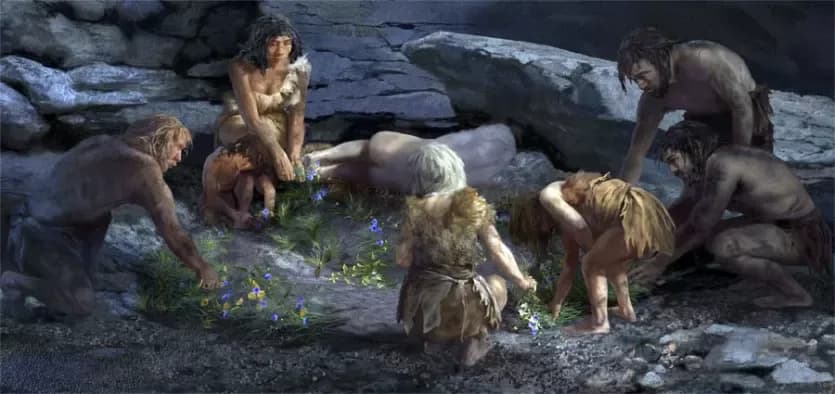
Shanidar Z was found with her left hand tucked under her head and a flat stone placed behind her skull, in a channel-shaped depression that micromorphology analysis confirmed was intentionally deepened by hand. She lies within a cluster of Neanderthal remains deposited near a prominent two-meter vertical rock that may have served as a grave marker. Bodies were deposited episodically over generations, suggesting the cave functioned as a "place of memory" for repeated ritual interment. Barker has noted that "everybody has taken Shanidar Z into their hearts as the mother of Kurdistan."
Equally remarkable was the 2022 discovery by Ceren Kabukcu and colleagues (Antiquity) of 70,000-year-old charred food just one meter from Shanidar Z, the oldest cooked plant remains in Southwest Asia. Neanderthals mixed wild grass seeds with pulses and used soaking, pounding, and grinding techniques to produce what researchers describe as a "flatbread-like" food, demonstrating sophisticated culinary culture.
The KRG museum initiative
The KRG has launched plans for a modern museum near Shanidar Cave, including a dedicated archaeological museum and cable car for visitor access. Barker advocates for UNESCO World Heritage status, stating: "Kurdistan has got one UNESCO World Heritage site, the citadel in Erbil, this has got the potential to be a second."